



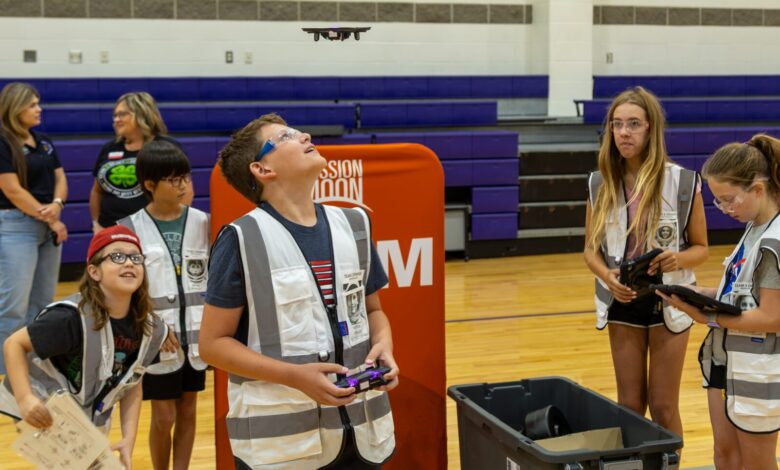
Four Artemis II astronauts recently traveled beyond the moon and back to Earth. Meanwhile, here in Iowa, youth in grades 4-12 have been experiencing NASA’s Artemis program through Mission Moon. They are exploring aerospace, building STEM skills and having fun. Not only are they learning what it takes to be an astronaut, they are discovering opportunities for their future in a variety of STEM careers.
Mission Moon is an immersive, hands-on learning experience from Iowa 4-H and the NASA Iowa Space Grant Consortium. In 2025, it was piloted during the State 4-H Youth Conference at Iowa State University, as well as in Boone, Delaware, Dubuque, Monona, Sac, Story and Woodbury counties. Additional pilots will wrap up this summer, and the program will officially launch with the Waukee Community School District this fall.
“Iowa 4-H and the NASA Iowa Space Grant Consortium are working together to equip youth with the critical thinking, problem-solving and innovation skills they will need for future careers and success in the workforce,” according to Sara Nelson, 4-H STEM specialist with Iowa State University Extension and Outreach. “Our ongoing partnership combines the extensive outreach capabilities of Iowa 4-H with the specialized science, technology, engineering and math education opportunities provided by the consortium.”
Offering challenge-based learning through exploration
The Mission Moon experience offers challenge-based learning, Nelson explained. “Youth learn as they explore real-world challenges. They identify big ideas, ask thoughtful questions and develop a range of skills as they determine solutions.”
As Mission Moon astronauts, youth use iPads to access a mission notebook, scan objects, record data and sketch designs throughout the experience. They use drones to collect data about the Moon’s geologic features as they scout for a landing site. They design and build a small rover as they figure out how to transport people and materials across the Moon’s surface. They use iPads with LiDAR to scan for minerals, and they work with micro:bits and radio signals to locate hidden reserves of water ice on a mock lunar surface. Youth face these and other challenges as a team and must communicate clearly to solve problems together.
Using iPads with embedded apps, AI and other technology supports what educators refer to as multimodal creativity: youth are creating and learning in multiple ways, Nelson said.
“When students are immersed in a simulation, they are learning through exploration. They’re not just completing a challenge; they are building confidence in what they can do and who they can become. By participating in Mission Moon, they’re exploring new frontiers in STEM and they’re developing workforce ready skills,” Nelson said.
Advancing K-12 STEM education
Iowa 4-H and the NASA Iowa Space Grant Consortium are part of the Collaborative for Advancing Science Teaching and Learning in K-12. The collaborative, known as CASTL-K12, is a project of the National Academies of Sciences, Engineering and Medicine. It connects national and state level science education stakeholders so they can learn from each other and share innovative ideas for implementing and supporting state-level science standards. Mission Moon is a focus project of this collaborative.
Mission Moon is one of the innovative programs that STEM educators and NASA Space Grant Consortiums from other states are interested in learning about, Nelson said.
“Mission Moon’s immersive STEM experiences, such as drone-based lunar scouting, rover engineering and regolith analysis, are capturing national interest because they address the critical need to develop a broad spectrum of STEM professionals, from technicians and data analysts to engineers and planetary scientists for our return to the moon,” Nelson said.
States across the country are drawn to Mission Moon because it brings space exploration to life for students through authentic, hands-on experiences that mirror real NASA missions.
“Our team at the North Dakota Space Grant Consortium was truly blown away by the level of engagement from every single young person participating in Mission Moon,” said Laurie Salander, NDSGC associate director.
“The excitement was palpable — one student even said, ‘I hope the rest of our day is this much fun.’ The program’s hands-on, reusable design, paired with meaningful engineering constraints like those used in the rover activity, creates an authentic STEM experience that sparks curiosity, creativity and genuine joy in learning,” Salandar said.
“From designing lunar habitats to simulating rover navigation and analyzing regolith samples, the program sparks curiosity and builds critical STEM skills in ways that are both imaginative and deeply relevant to future careers in aerospace, robotics and planetary science,” Nelson added.
Mission Moon also is developing the next generation of STEM educators.
“We’ve trained undergraduate students in delivering Mission Moon. They know the technology, they know the concepts and they’re already delivering the program to youth throughout the state,” Nelson said.
Mission Moon is poised for growth, with plans to expand access to immersive STEM experiences across all 99 Iowa counties and beyond, Nelson noted. With support from Iowa 4-H Youth Development and the NASA Iowa Space Grant Consortium, the initiative aims to scale up through youth space camps, mobile STEM simulations, public library kits and national challenges that empower educators and students to engage with space science and STEM careers.
About Iowa 4-H and STEM
Iowa State University Extension and Outreach’s 4-H Youth Development program provides Iowa’s young people with an education pathway to STEM careers. Throughout 2024-2025, Iowa 4-H engaged Iowa youth in more than 21,000 individual STEM learning experiences that connected to their lives and responded to their interests.
“Iowa 4-H prepares youth with the skills and confidence to succeed in STEM and be ready for community college, university or other training programs that lead to STEM careers,” Nelson said.
For more information about Mission Moon and other 4-H STEM activities, contact Sara Nelson, sdnelson@iastate.edu, or visit the Iowa 4-H website.
About the Iowa Space Grant Consortium
A part of NASA’s National Space Grant College and Fellowship Program since 1990, the Iowa Space Grant Consortium continually strives to improve and inspire Iowa’s future in science, technology, engineering and math. The ISGC supports NASA-relevant STEM research, education and outreach activities for all Iowans with NASA internships, fellowships, and scholarships, competitions for grants within higher education members (with NASA Mission Directorate alignment), as well as informal education grants with outreach affiliates.
Stay Connected with Mix 107.3 KIOW
Add Mix 107.3 KIOW as a preferred source on Google to see more local news, weather, and sports in your feed.
Follow us on Facebook for breaking news, severe weather alerts, sports, and more.